The Challenge
Whenever stainless steel and concrete come into direct contact, there’s potential for long-term material interaction. In this case, the aim was to prevent that at the fixing point.
The complication came from the shape and size of the component itself. The geometry limited how the part could be moulded. Full automation wasn’t realistic, so production would need to be semi-automatic.
That has knock-on effects. Output speed changes. Tooling becomes more involved. Unit cost needs careful control. So the task wasn’t just to create an insulating socket - it was to make sure it could be produced sensibly, without pushing the price beyond what the customer could accept.
Our Approach
When we reviewed the drawings, the first step was material selection. The part needed strength, dimensional stability and reliable insulating properties. After discussion, Nylon 66 was chosen as it offered the right balance for the application.
From there, attention turned to how the part would actually be moulded. Because of its physical form, the tooling required an extractable core. That decision shaped the manufacturing process and confirmed that production would remain semi-automatic.
There are always constraints with bespoke injection moulded components. The key is recognising them early and designing around them rather than discovering them later.
At Allthread Plastics, that practical step usually makes the difference between a smooth approval and multiple revisions.
The Outcome
The component was approved at version one. That doesn’t happen every time, but in this case the early discussions around the material and moulding paid off.
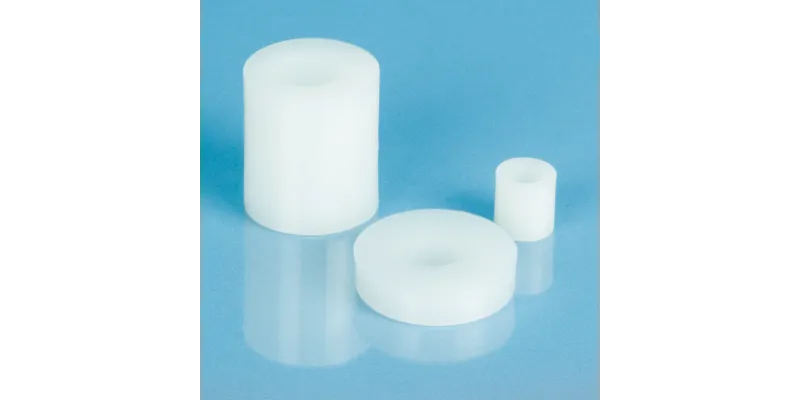
The finished anchor stud socket now provides a consistent insulating barrier between stainless steel and concrete within a railway infrastructure setting. It is still in use and continues to perform as intended.
Despite the limitations of a semi-automatic process, we were able to produce the part within the customer’s pricing expectations and at the highest volumes the process allowed.
Most importantly, the original issue was resolved. The interaction between materials was addressed at source, helping extend the lifespan of the wider assembly.
Materials and Production Details
- Material: Nylon 66
- Manufacturing method: Injection moulding
- Production process: Semi-automatic, dictated by component geometry
- Design basis: Produced to the customer’s drawing, with moulding constraints accounted for.
Key Takeaway
“This project demonstrates how practical manufacturing experience can refine an established process. By understanding how the component would actually be used - not just how it was drawn - we were able to deliver a solution that made a measurable difference.”


 Explore Our Catalogue
 Custom Plastic Parts